|
CLASSICAL LOST AND FOUND
(CLOFO) FORGOTTEN MUSIC BY GREAT COMPOSERS AND GREAT MUSIC BY FORGOTTEN COMPOSERS |
|---|
|
31 AUGUST 2025
CROCKS NEWSLETTER
The albums below are "Classical Releases Of Current Key Significance," or "CROCKS", if you will. To purchase an album, simply click on one of the web site retail outlets given in the "AVAILABILITY" table under the write-up.
|
|---|
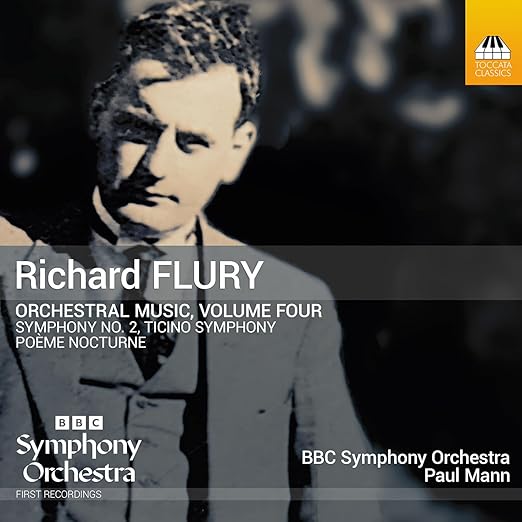
Flury, R.: Orchestral Music V4 (Symphony No. 2 in A minor "Ticino Symphony", Poème nocturne), Mann/BBC SO [Toccata]
RECOMMENDED (1 CD)
Over the last two years, we've told you about some music on the Toccata label by Swiss composer-conductor Richard Flury (1896-1967; see 31 August 2023 and 30 June 2024). Now they give us their fourth volume of his orchestral music. The album booklet provides a wealth of information about his life and work, so we'll just hit the high points.
Richard was born to a musical family in Biberist, Switzerland, some 100 miles north-northeast of Geneva. He studied violin, composition, counterpoint, orchestration and conducting at three Swiss Universities as well as in Vienna. Then Flury taught violin in his hometown area, and conducted throughout Switzerland. He was also one of that country's most prolific composers, and his music is of late romantic disposition. That said, Richard died in Biberist (see above), leaving many works across all genres. This release gives us two more in the orchestral category. Beginning in 1932, Flury spent holidays with his family in Lugano, which is located in Switzerland's southernmost canton of Ticino. This borders Italy, and Italian is the official language. Consequently, it inspired the first selection on this CD, namely Richard's four-movement Symphony No. 2 in A minor "Ticino Symphony" (1936). An "Allegro (Fast)" first movement [T-1] begins with a forceful, drum-pounding, orchestral preface [00:01] that conjoins a lovely episode [02:16], which seemingly depicts this area's beautiful landscapes. It's apparently based on a motif associated with the five-bell-toll that emanates from the tower behind Lugano's, Church of Santa Maria di Pazzalino to announce services. As for the music here, it consists of scenic passages that range from rolling [04:19] to smooth [06:05], hilly [08:17] and flowing [09:27]. Then a lofty one [12:00] brings this movement to an abrupt conclusion. The "Andante (Slow)" second [T-2] commences with an extended, calm, comely melody [00:00]. It's the subject of a subsequent barcarolle-like offering, where this theme undergoes a captivating, developmental exploration [01:54]. In the process, it alternately waxes and wanes, thereby calling up nostalgic memories of the opening measures [11:02] that end things tranquilly. An "Allegro molto (Very fast)", spry "Scherzo" follows [T-3]. This is based on the melody for the Italian folksong "Quattro cavai che trottano" (play song). Here zippy segments [00:00, 04:27, 06:16] alternate with related, more tuneful ones [02:52, 05:45]. And then the composer caps this movement with a sprightly coda [08:03]. The "Allegro (Fast)" marked "Finale" [T-4] is a rondo of rather bellicose disposition. It starts with a pugnacious preface [00:01] having hints of an upcoming, main refrain theme. The latter soon appears in full [00:25] and borrows the melody for the popular Italian song "Addio la Caserma (Goodbye the barracks)". Subsequently, this idea alternates with several episodes that range from searching [01:02] to melancholy [03:33], martial [05:01], playful [07:04], tarantella-like [07:28] and whimsical [09:12]. Then a victorious one [10:41] with a glorious coda [13:41] closes the work decisively. Richard's "Poème nocturne" of 1939 follows [T-5]. He once referred to it as "kind of a dream fantasy", and this comes off somewhat like Richard Strauss's (1864-1949) "Death and Transfiguration", Op. 24, TRV 158; 1888-89). Flury's piece begins with affecting passages [00:01] that wax and wane, thereby limning an oneiric mind-set. Then there's an "Allegro (Lively)", somewhat orgiastic episode [04:32]. However, this ebbs into moving recollections of the opening moments [07:39]. These gradually become quite intense, but slowly wane into more past memories [15:10], which end the work as well as this disc somewhere beyond dreamland. The performances are by the BBC Symphony Orchestra (BBC SO) under British conductor Paul Mann (b. 1965). They were based on new versions of these selections commissioned from Maestro Mann by the Ricard Flury Foundation. He's previously recorded a number of this composer's works for Toccata (see the album notes) and makes a strong case for the ones here. All three recordings were made 25-28 September 2023 at the BBC's capacious Maida Vale MV1 Studio in London. They deliver consistently good sonic images of this music in pleasant surroundings and faithfully capture Flury's consummate scoring. The overall instrumental timbre is characterized by glittering highs, a satisfying midrange and transient bass. -- Bob McQuiston, Classical Lost and Found (CLOFO.com, P250831) |
|---|
| - AVAILABILITY - | |
|---|---|
| Amazon | ArkivMusic.com |
Gipps: Orch Wks V4 (Violin Concerto, Leviathan..., Symphony No. 5); Lovell-Jones/Anderson/Gamba/BBC Phil [Chandos]
AUIOPHILE (1 CD)
It's been too long since English-composer Ruth Gipps (1921-1999) has appeared in these pages! Consequently, this recent Chandos release is most welcome, particularly as all three selections are premiere recordings. Incidentally, Ruth was also an accomplished oboist, pianist, conductor and educator.
Born in Bexhill (aka Bexhill-on-Sea), some 70 miles south-southeast of London, Gipps' parents were musically oriented in that "Dad" was a trained violinist, and "Mom", a Swiss-born piano teacher. Consequently, Ruth studied piano as a youngster, gave her first public performance at age 4, and concertized regularly during her teens. However, the year 1937 saw this talented 16-year-old enter London's Royal College of Music (RCM), where her instructors included such greats as Ralph Vaughan Williams (1872-1958). Ruth then journeyed to Durham, some 270 miles north of London, where she continued her studies at Durham University, from which she got a BMus (1941) as well as her DMus (1948). And subsequently, this lady taught at Trinity College London (1959-66) in addition to the RCM (1967-1977). Unfortunately, a shoulder injury sustained sometime during 1954 ended Gipps' career as a soloist. Consequently, she then pursued a highly successful one conducting and writing a great deal of music. That said, Ruth lived in London for most of her later life until her retirement to the Bexhill area, where she'd been born (see above). This talented lady would die there, and leave a significant body of works across most genres Written when Ruth was only 21, her Violin Concerto in B flat major, Op. 24 (1943) is a substantial, three-movement composition. The first one [T-1] begins with a "Moderato (Moderate)" introduction, where the orchestra [00:03] and soloist [00:21] hint at a lively theme soon played by the latter [00:42]. This idea is explored in comely, woodwind-spiced passages, which adjoin "Meno mosso (Less lively)", more introspective ones [05:14]. Then an "A tempo (At the first speed)", fugally introduced, captivating episode ensues [06:33]. But it ebbs into a "Meno mosso (Less lively)" [11:06] segment, where the movement simply fades away. The middle "Andante (Slow)" one [T-2] opens with a gentle thought for all [00:01]. It's the subject of an endearing, rustic rhapsody having ardent [02:10, 04:06, 05:28] as well as mellow [02:52, 04:27] moments. Then the last of these bridges attacca into the closing movement [T-3]. This starts with the soloist playing an "Allegro (Fast)", frenzied ditty [00:00] having a perky orchestral accompaniment. Then the foregoing ebbs into an "Adagio (Slow)" segment [01:54], which is a soothing respite that's played slower than the preceding "Andante" movement. However, a sudden, fortississimo (fff), orchestral chord and snarling snare drum trigger a "Tempo di marcia (March speed)", bellicose episode [02:41]. It becomes a "Meno mosso (Less lively)" undertaking [04:19] with comely solo oboe [04:39] and violin [05:13] tidbits. There's also a cryptic, fortissississimo (ffff) gong crash [06:58], but things then continue "L'istesso tempo (At the same speed)" [07:14] with some sensitive commentary by the soloist. However, the pace quickens with fiddle fireworks' emblazoned "Allegro (Fast)" [08:36] plus "Presto (Very Fast)" [08:56] passages that bring the piece to a stunning conclusion. Gipps wrote many works for a variety of performing forces as evidenced by the next selection. It's titled "Leviathan for Solo Double-bassoon and Chamber Orchestra", which is her Op. 59 of 1969 [T-4]. Incidentally, a double-bassoon is also known as a contrabassoon, and for simplicity's sake, we'll refer to it as "d-b". While the impetus for this piece is unknown, it may relate to that "Leviathan" mentioned in verse 26 of Psalm 104. Anyway, there's an "Andante lugubre (Slow and mournful)" preface for orchestra [00:00] and d-b [00:06], which turns "Più mosso (More lively)" [00:50]. Then the soloist plays a couple of low notes [02:28] that conjoin an "Allegro (Fast)" section [02:32]. And after a brief pause, there's a "Meno mosso (Less lively)" d-b cadenza [03:14]. It's followed by more "Andante lugubre (Slow and mournful)" passages [03:40] that become "Allegro (Fast)" [04:04], thereby ending this bizarre selection, presumably as Ruth's sea serpent swims away. Her Symphony No. 5, Op. 64 (1982), which she inscribed to Sir William Walton (1902-1983), fills out this release. At almost 40 minutes, the last of its four movements is one of a kind -- but more about that later! As for the first [T-5], this has a "Moderato maestoso (Moderate and majestic)" introduction [00:00] that turns "Allegro vivace (Fast and spirited)" [01:30]. Then there's a pensive "Andante (Slow)" idea [03:33], which adjoins an "Allegro vivace (Fast and spirited)" one [04:52]. The latter evokes an "Andante (Slow)" contemplative episode [06:47]. However, the music again turns "Maestoso (Majestic)" [07:57] as well as "Poco più mosso (A little more lively)" [10:01]. But it then wanes into "Meno mosso (Less lively)" harp-hued passages [11:40] that end the movement quietly as they slowly fade away. The subsequent, ephemeral, "Andante (Slow)" one [T-6] is a piquant morsel. Here we get some comely, opening wind passages [00:00] featuring a cor anglais as well as an oboe. These wax and wane into a lovely, concluding, violin moment [03:19]. After that, there's a spirited "Scherzo" [T-7] that begins with a bustling, "Allegro (Fast)" number [00:00]. This scurries about in colorfully scored passages that come to an abrupt halt. Then Gipps serves up a charming, related, vibraphone-spiced trio section with a couple of "Meno mosso (Less lively)" marked segments [02:12 & 04:31]. And subsequently, a "Scherzo da capo (Scherzo from the beginning)" one [05:40] ends things full circle with a thrilling "Coda" [07:32]. The last movement is a "Missa brevis for Orchestra". Its score bears the first line of Psalm 127; eg., "Except the Lord build the house, they labour in vain that build it." This has six marked parts that play attacca, but have separate, consecutive track numbers. The first "Largo (Slow)" one [T-8] is made up of a hallowed, horn-invoked "Kyrie eleison (Lord, have mercy)" [00:00 & 01:10] on either side of a woodwind-enjoined "Christe eleison (Christ have mercy)" [00:50-01:09]. Subsequently, there's an "Allegro (Fast)" [T-9], grandiose "Gloria in excelsis Deo (Glory to God in the highest)" [00:00] and "Meno mosso (Less lively)", tranquil "Et in terra pax hominibus bonæ voluntatis (And on earth peace to people of goodwil)" [00:59]. Then we get a pious "Credo in unum Deum (I believe in one God)" [T-10, 00:00], followed by an "Allegro (Fast)" brass-heralded, elated "Hosanna in excelsis (Glory in the highest) [T-11, 00:01]. This gives way to a "Meno mosso (Less lively)", mellow "Benedictus qui venit in nomine Domini (Blessed is he who comes in the name of the Lord)" [00:53]. However, a "Da capo del Hosanna (Hosanna from the beginning)" follows [01:31]. It adjoins a "Meno mosso (Less lively)", imploring "Angus Dei qui tollis peccata mundi, miserere nobis (Lamb of God, who takes away the sins of the world, have mercy on us)" [T-12, 00:00]. Then a "Coda" [T-13] hinting at past ideas begins "Allegro moderato (Moderately fast)" [00:00], but wanes into "Largo (Slow)" passages [01:16]. These gradually fade away, thereby bringing the work and disc to a prosaic conclusion. The performances are by the BBC Philharmonic (BBC Phil) under British conductor Rumon Gamba (b. 1972). They're joined by Welsh violinist Charlie Lovell-Jones (b. 1999) for the "Concerto", whereas "Leviathon" features this orchestra's bassoonist, namely British-born-and-trained Bill Anderson (see the album booklet). All superb musicians, they deliver what would seem to be authoritative renditions of these three selections. As for recordings, they took place 29 July 2022 [T-4], 24 May 2024 [T-5 thru 12] and 20 November 2024 [T-1 thru 3] in Salford, England, some 200 miles north-northwest of London. All were made at the MediaCityUK's Concert Hall, which is a good venue with just the right amount of reverberation. They consistently project generous sonic images of the orchestra with the soloists centered, well captured and highlighted against it. The overall instrumental timbre is excellent with pleasant highs, a satisfying midrange and clean bass. -- Bob McQuiston, Classical Lost and Found (CLOFO.com, Y250830) |
|---|
| - AVAILABILITY - | |
|---|---|
| Amazon | ArkivMusic.com |
Petrassi: Concertos for Orchestra Nos. 1-3; La Vecchia/OrSinfaR [Naxos]
RECOMMENDED (1 CD)
With this recent Naxos release we welcome Italian composer-conductor-teacher Goffredo Petrassi (1904-2003) to these pages. He was born in Zagarolo, just 20 air-miles east-southeast of Rome. Then during 1911 the Petrassi family moved to Rome, where Goffredo became a choirboy at the San Salvatore in Lauro church located in the center of that great city. And at the age of 15 (1919) he began working at a music store to help with his family's financial needs.
During 1928, Goffredo entered the Santa Cecilia Conservatory (Accademia Nazionale di Santa Cecilia) in Rome, where he studied organ and composition for five years. And after graduation in 1933, Petrassi held prestigious teaching positions in Salzburg, Austria (1937-40), as well as Rome (1940-60) and Venice (1960-78), which is some 300 miles north of there. All through those years and right up until 1986, when his eyesight began to fail, this composer produced a substanial body of works across all genres, in addition to several film scores. That said, he died in Rome at age 98. This release features the first three of his eight numbered "Concertos for Orchestra (Concerti per orchestra)", which are so named because they each highlight several instruments. More specifically, these come off like Concerti Grossi of Neoclassical design. Their predecessors include such great works as Johann Sebastian Bach's (1685-1750) "Brandenburg Concertos" (1713-21) plus ones with the same title as Petrassi's, which are by the likes of Paul Hindemith (1895-1963) and many others. The three-movement "Concerto No. 1 for Orchestra (Primo Concerto per orchestra)" (1933-34) begins with an "Allegro (Fast)" marked one [T-1]. This has a spunky brass-introduced opening theme [00:01] with a peppy piano tidbit [00:13], and adjoins a somewhat martial second thought [02:27]. Then the foregoing ebbs into somewhat contemplative passages [04:34] tinged with an eerie alto saxophone [04:45-06:06]. However, the first idea returns [06:30] with plucky piano moments and ends the movement in the same spirit as it began. A mystical, ">Adagio (Slow)" one follows [T-2] with a tender, opening tune for strings [00:01] having some piano spicing. It's succeeded by a meditative conversation involving a clarinet [01:35] and oboe [01:42]. Then the other woodwinds [02:10] plus trumpets [02:35] appear as the music waxes and wanes into piano-ostinato-laced passages [03:22]. These become increasingly powerful, brass-enforced remembrances of past moments. But they subsequently die away with a wistful saxophone [07:21], thereby closing this movement somewhat dolefully. The final, "Tempo di marcia (March speed)" marked one [T-3] is a busy piece of work. It gets off to a truculent start with several, dogmatic chords [00:00] plus a brash, first idea [00:23]. This is followed by a whimsical second [01:16], which parents some captivating, melodic passages [02:46]. Then these wane into the return of that first thought [05:31], and more of those chords [05:40], which bring the work to a forceful finish. Petrassi's "Concerto No. 2 for Orchestra (Secondo Concerto per orchesta)" (1951) is in four, shorter movements, which play continuously. That said, the first [T-4] has an initial, attention-getting chord [00:00] succeeded by a delicate, "Calmo e sereno (Calm and Serene)" episode for the strings [00:06]. Then they're joined by the woodwinds [01:39] and there's a curt, passing orchestral outburst [02:47-02:53]. However, a couple of minutes later, the music becomes "Molto mosso con vivacità (Very moving and vivacious)" [05:23]. The foregoing adjoins an "Allegretto tranquillo (Lively and tranquil)" second movement [T-5], where a drum-beat {00:00] heralds more woodwind-string dialogue. But it slows and conjoins a "Molto calmo, quasi adagio (Very calm and somewhat slow)" third [T-6, 00:00]. Here the woodwinds have a captivating conversation supported by other members of the orchestra. This waxes and wanes into a striking woodwind chord [03:32], which calls up the closing "Presto (Fast)" movement [T-7. 00:00]. Here we get increasingly quicker, racy passages, where the solo instruments play tag with one another. These bring the piece to a consummate, resolute conclusion. The "Concerto No. 3 (Terzo Concerto per orchestra)" (1952-53) fills out this release. It's also called "Récréation concertante (Recreational Concerto)", and has five short movements that play continuously. Moreover, the first one [T-8] begins [00:00] "Allegro sostenuto ad energico (Fast, sustained and energetic)" with percussion and brass outbursts. These are followed by agitated passages for the woodwinds and strings [00:40], where they banter about. But reminders of the opening measures then appear [03:50], succeeded by an "Allegro spiritoso (Fast and playful)" segment [04:13]. Here combative chords conjoin the "Molto moderato (Very moderate)" second movement [T-9]. This is intermezzo-like and begins with the horns [00:00], woodwinds [00:05] and upper strings [00:16] playing a delicate tune. It affixes a percussive tidbit [03:24], which adjoins the next "Vigaroso e ritmico (Lively and rhythmic)" marked scherzoesque middle movement [T-10]. Here a variety of instruments dart about in perky outer sections [00:00 & 04:17]. They surround a more tuneful trio midriff [02:24-04:16] and make an attacca transition into the penultimate, "Adagio moderato (Moderately slow)" one [T-11]. It has pensive opening moments [00:00], which actuate a delicate woodwind-string serenade [02:21]. Then this makes a chortling transition into the closing "Allegretto sereno (Lively and lucid)" last movement [T-12, 00:00]. It's a jocular affair, having skittish, colorfully scored passages where the instruments twitter about. But the music briefly ebbs [01:44], only to make a fast, fulminant exit [02:34], thereby ending the work and CD rather curtly. All three performances are by the Orchestra Sinfonica di Roma (OrSinfaR or RSO) under its artistic-musical director, Italian conductor Francesco La Vecchia (b. 1954). These superb musicians deliver articulate, technically accomplished accounts of all three works. The recordings were made 15-16 June [T-4 thru 7] 2012 in the OSR Studios, and then 24-25 February [T-8 thru 12] as well as 21-22 April [T-1 thru 3] 2013 at the Auditorium Concilianzions in Rome. Despite the different times and locations, they present clarion sonic images of the orchestra in excellent venues. The overall orchestral timbre for these colorfully scored works is generally good with acceptable highs, as well as a satisfactory midrange and clean bass. -- Bob McQuiston, Classical Lost and Found (CLOFO.com, P250829) |
|---|
| - AVAILABILITY - | |
|---|---|
| Amazon | ArkivMusic.com |
Saint-Saëns: Introduction and Rondo..., Violin Concertos Nos. 1 & 2, Havanaise…; Zhu/Griffiths/ORF VRSO [Berlin Classics]
RECOMMENDED (1 CD)
Five years have passed since this renowned French composer last appeared in these pages (see 30 April 2020). Camille Saint-Saëns (1835-1921) was an enfant-prodige, who became a polymath (see the album booklet) and left a prodigious oeuvre across all genres.
This winsome new release from Berlin Classics introduces young, aspiring British violinist Leia Zhu (b. 2006). She delivers four of this composer's concertante works written for her instrument, and there's never a dull moment! Accordingly, things get off to a propitious start with the "Introduction and Rondo Capriccioso in A minor, Op. 28" (1863) [T-1]. It began life as a three-movement violin concerto, which was inspired by Spanish virtuoso Pablo de Sarasate (1844-1908). However, seemingly for commercial reasons (see the album booklet), Camille reworked it into the 10-minute delight presented here. This has a subdued orchestral introduction [00:01], but the soloist soon appears [00:07], and together they launch a winsome, refrain-like, thematic nexus. It powers a variety of segments, the most notable ranging from vivacious [01:41, 03:14, 05:47, 08:06] to flighty [02:27, 07:25] and songful [04:22], as well as frantic [03:44, 06:16]. Then there's a brief violin cadenza [08:26-08:40], followed by a whirlwind, closing coda for all [08:45]. Saint-Saëns wrote three violin concertos, and his "Concerto No. 1 in A major, Op. 20" (1859) is next. Structurally speaking, it's somewhat of an oddity with three connected, movement-like segments that only last about 12 minutes. That said, the first "Allegro (Fast)" one [T-2] begins with a dashing introduction for all [00:01] hinting at a lovely, violin-embroidered theme, which soon appears [00:29]. Then the latter is followed by a related, more lyrical thought [01:29], and both busily call up hearty reminders [02:54] of the first measures. They make an animate transition with a curt, cadenza-like link [04:28] into the second "Andante espressivo (Expressively flowing)" segment [T-3, 00:00]. It features a gorgeous, violin-gilded tune [00:36] that fosters a captivating, pastoral serenade [02:10]. This adjoins melancholy memories [01:55] of past thoughts, which make a lively, attacca transition into the closing, spirited "Reprise" [T-4, 00:00]. It's a recap of the opening segment, but with the two main ideas reversed. Here the violin makes an ultimate heavenly ascent [03:40], and the orchestra closes things with a rousing cadence [03:51]. Camille's "Concerto No. 2 in C major, Op. 58 (1958) is next. It has the usual three movements and lasts about thirty minutes. We might also note that this was actually written before the one above, but published after same, so it has a later Opus number. The opening movement [T-5] gets off to an "Allegro moderato e maestoso (Moderately fast and majestic)" start with a scurrying orchestral introduction [00:01]. During this, the soloist appears and plays a showy, wide-ranging, first theme [00:06], followed by a complementary, sighing second [00:48]. Then both receive rousing tutti approval [01:21], succeeded by a commanding version of that first idea [02:18]. However, it wanes into delicate passages for all, which evoke a winsome violin memory of the second one [04:10]. This adjoins orchestral reminders of other previous moments [06:08, 08:30, 09:36, 10:39], which herald a lengthy, demanding violin cadenza based on past thoughts [10:58-13:06]. It's followed by an "A tempo più allegro (At a somewhat faster speed)" reappearance of the tutti [13:07] that concludes the movement triumphantly. The middle "Andante espressivo (Expressively flowing)" [T-6] begins with a hesitant motif for the orchestra [00:01] and soloist [00:10]. This is the subject of several treatments that range from pensive [00:33] to aria-like [01:35], martial [02:55], searching [03:43], anxious [05:39] with a cadenza-like moment for the violin [05:50], and romantic [06:08]. Then an oboe-tinted, plaintive, reminder of the movement's opening measures [07:47] bridges attacca into the last "Allegro scherzando (Fast and playful)" rondoesque one [T-7]. This is "ABACA" structured, and has an exuberant initial "A" played by all [00:04]. It conjoins a vivacious "B" [01:53] as well as another elated "A" [02:20]. And after that, we get a capricious "C" [03:21] plus a third "A" [04:11]. But the latter turns fugal [04:56] with a final stretto [06:42], which ends the work victoriously. The closing "Havanaise in E major, Op. 83" (1887} [T-8] was written for Cuban violinist Rafael Díaz Albertini y Urioste (1857-1928). This has a mellow orchestral preface [00:02] soon followed by an appealing, extended violin melody [00:25] that's rhythmically of Habanera temperament. Subsequently, the foregoing parents piqued passages [02:46] that dart around a winsome, central episode [03:26-08:11], where the soloist is predominant. Then the pace quickens [08:12] with some fancy fiddling set to a vehement, orchestral accompaniment. However, it wanes into a closing segment [09:17], which could seemingly limn a warm, Cuban, summer night. As we noted above, the CD features up-and-coming British violinist Leia Zhu (b. 2006). She delivers elegant accounts of the well-known first [T-1] and last selections {T-8] as well as those less familiar middle ones [T-2 thru T-7]. This talented young-lady gets primo support from the ORF Vienna Radio Symphony Orchestra (ORF VRSO) under British-Swiss conductor Howard Griffiths (b. 1950). The recordings were made during November 2023 at the ORF Kulturhaus Großer Sendsaal located in Vienna. They present consistently generous sonic images of these proceedings in a good venue, whose acoustics enrich this music. Miss Zhu is positioned just left of Maestro Griffiths with her violin, well captured and highlighted against the orchestra. The overall instrumental timbre is characterized by pleasant highs, good mids and clean bass. -- Bob McQuiston, Classical Lost and Found (CLOFO.com, P250828) |
|---|
| - AVAILABILITY - | |
|---|---|
| Amazon | ArkivMusic.com |
| - SEE OTHER CLOFO SERVICES - | ||||
|---|---|---|---|---|
| AUDIOPHILE SELECTIONS | BEST FINDS OF LAST YEAR | CLOFO HOME PAGE | CLOFO RECOMMENDATIONS | OTHER CROCKS NEWSLETTERS |