CLASSICAL LOST AND FOUND
(CLOFO)
FORGOTTEN MUSIC BY GREAT COMPOSERS AND GREAT MUSIC BY FORGOTTEN COMPOSERS


31 JULY 2025

CROCKS NEWSLETTER

The albums below are "Classical Releases Of Current Key Significance," or "CROCKS", if you will. To purchase an album, simply click on one of the web site retail outlets given in the "AVAILABILITY" table under the write-up.


The album cover may not always appear.
Andrée, Elfrida: Fritiof-Svit, Symphony No. 1 in C major; Bäumer/Norrköping Symphony Orchestra [CPO]
Swedish composer Elfrida Andrée (1841-1929) makes her CLOFO debut with this recent CPO release. She was born in Visby on the island of Gotland and showed an interest in music as a ten-year-old. Then by age fourteen (1855), Elfrida began private organ lessons in Stockholm, some 130 miles north of her hometown.

Some six years later (1861) this young lady, who'd been a strong proponent of women's rights, was one of the first female organists to be appointed in Scandinavia. And by 1867 she'd become the organist at Gothenburg Cathedral, which is about 250 miles southwest of Stockholm.

Then the year 1897 saw her conduct some concerts in Gothenburg, thereby making her the first Swedish woman to hold such a position. That said, Andrée would live out her life there and leave some 120 works across many genres. However, there's no detailed catalog of them readily available as of now.

This release begins with Elfrida's "Fritiof-Svit (Frithiof Suite)". It has five-movements, was written around 1912, and is drawn from the music for her opera titled "Fritiof's Saga (Frithiof's Saga)" of 1898. Incidentally, the latter is based on Swedish writer Esaias Tegnér's (1782-1846) epic poem derived from the Icelandic legend, Frithiof's Saga (ca. 1300).

The story behind this music centers around Frithiof, who was said to be the tallest, strongest and bravest of men. It also involves his seagoing trip, presumably to the Orkney Islands (aka Orkney). And additionally, it references his inamorata and eventual wife, Ingeborg, as well as her previous husband, King Ring.

Things get underway with a "Maestoso (Majestic)" marked "Förspel (Prelude)" [T-1]. It has a stately opening preface [00:02], followed by a lovely melody [01:10] that's developed [02:04]. Then there's an amorous second idea [03:08], which parents delicate passages [04:07]. These become quite outspoken [04:51], but quickly wane into humble ones [04:55] with bits of previous thoughts. However, triumphant moments {05:55, 06:11, 07:20] recalling the opening measures close the movement heroically.

The next "Ingeborgs klagan (Ingeborge's lament)" is an "Andantino (Leisurely)" offering [T-2] that begins with a delicate thought [00:01]. This is the substance of a tender musical representation of her grief, ostensibly over her separation from Frithiof, and ends sadly.

But the following "Andantino maestoso (Flowing and majestic)" marked "Rings drapa (King Ring's ode)" [T-3] is a captivating pronouncement. Moreover, soon after its regal start {00:01], the music depicts what could be images of imposing lands [99:25] as well as a grandiose citadel [02:10]..

However, the next "Fritiofs svämeri (Frithiof's romance)" [T-4] is an "Adagio (Slow)" paced, amorous affair. This opens with a subdued thought that's somewhat reminiscent of the work's preface (see above). And subsequently, it's the main ingredient for a warm serenade. This ostensibly expresses our hero's feelings for Ingeborge and ends tenderly.

Then we get the "Allegro agitato (Fast and exited)" final movement titled Fritiofs färd på havet (Frithiof's sea voyage)" [T-5]. It's a moving, musical depiction of that above mentioned trip of his to the Orkney Islands. This dramatic piece of work starts with a foreboding theme [00:01]. And afterwards, there's a gallant episode [01:24] succeeded by combative passages [02:13, 03:41]. But the latter give way to amorous ones [04:33, 05:24, 06:36] that close things tranquilly.

Andrée's Symphony No. 1 in C major (1868) fills out this invaluable release, and holds the distinction of being the first written by a Nordic woman. It has four movements, and the initial, "Allegro (Fast)" one is probably best described as a theme and variations [T-6]. Here restless initial passages [00:02] hint at a tuneful main subject that's soon heard [01:27] and repeated [02:17].

Subsequently, the latter undergoes several variational treatments, which range from wistful [03:29] to commanding [04:36], playful [04:54], pensive [05:31], merry [06:04] and confident [06:39], Then there's a brief pause followed by a terse, increasingly forceful version [07:38], which closes the movement with a fortissimo chord for full orchestra.

After that, Elfrida serves up an "Allegro moderato (Moderately fast)" second one [T-7], which the album notes refer to as an "Intermezzo". This resembles a minuet, and starts with delicate, contrapuntally spiced passages [00:01] that parent a winsome, dancelike idea [01:19].

Then the latter is examined [02:02], repeated [02:21] and followed by a brief pause. It then becomes the material for a compelling, complementary "Trio" section [04:39-05:46]. However, remembrances of the opening measures surface [05:47], thereby ending the movement in much the same spirit as it started.

The "Andante con moto (Slow with movement)" third [T-8] is a ten-minute contemplation of an opening, arcane thought [00:01]. It becomes somewhat optimistic at a couple of places. [03:54, 05:59]. But then the music turns somewhat searching [07:55] and concludes rather despondently [09:43].

However, gloom turns to gladness in the "Allegro (Fast)" marked "Finale" [T-9]. This seems to be another theme and variation (see above), and starts with a jubilant thought [00:00]. Then the latter appears in several guises, which are sequentially exultant [01:43], playful [02:17], dancelike [03:34], cogent [04:11], delicate [04:47], as well as commanding [06:01]. And subsequently, there's a pause followed by spirited [06:46] plus martial [07:44] variations, which close the work and this CD in rousing fashion.

These performances are by the Norrköping Symphony Orchestra, which is based some 100 miles southwest of Stockholm. Under German conductor Hermann Bäumer (b. 1965), who's known for championing music by forgotten composers, they deliver proficient renditions of both selections, which will undoubtedly be definitive for some time to come.

The recordings were made 29 August through 1 September 2022 at De Geerhallen in Norrköping. They present consistently generous sonic images of the orchestra in somewhat dry surroundings. The sundry soloists and instrumental groups are effectively captured and highlighted. As for the overall orchestral timbre, it's characterized by acceptable highs, an adequate midrange and lean lows.

-- Bob McQuiston, Classical Lost and Found (CLOFO.com, P250731)

- AVAILABILITY -
Amazon ArkivMusic.com


The album cover may not always appear.
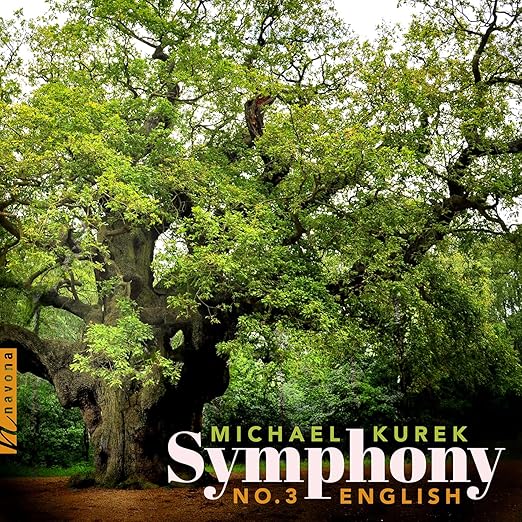
Kurek, Michael: Symphony No. 3 "English"; Fountain/European Recording Orchestra [Navona]
AUDIOPHILE (1 CD)
Award-winning, increasingly-acclaimed American composer Michael Kurek (b. 1955) holds a doctorate in music composition from the University of Michigan (UMich) and taught that subject at Vanderbilt University (Vandy) for 14 years. To date, he's written a significant body of works across most genres and we're treated to one in the symphonic category on this recent Navona Records release.

Kurek tells us in the informative album notes that he's an anglophile, and consequently we get his Symphony No. 3 "English", which was written in 2023-24. This piece is a musical travelogue of Late-Romantic persuasion, each of whose four movements honors a different aspect of that country as indicated in its subtitle. The composer also acknowledges this piece shows the influence of Edwardian composers.

"Upon a Walk in the English Countryside" [T-1--14:25] reflects the feelings aroused in Michael by some of this country's beautiful landscapes. This scenery also inspired such great British artists as John Constable (1776-1837) and William Turner (aka J.M.W. Turner; 1775-1851) to immortalize it in paintings (see one).

Kurek's music begins with a lovely. moving panoramic theme [00:00] that adjoins a delicate, bucolic one [03:41]. These bridge into a more spirited, flighty, dramatic segment [05:08], which becomes quite impassioned. However, the latter wanes into somewhat melancholy passages [07:26] that turn {beginning at 09:53] increasingly dramatic. But these wane into nostalgic memories of the past [11:39], which end the movement with delicate hints [13:41] of its opening measures.

"Stonehenge" [T-2--10:14] honors that impressive megalithic structure built around 3100-1600 BC on Salisbury Plain, some 80 miles south-southwest of London. The music begins softly [00:01] indicative of the mysteries about this site, which was probably related to the summer and winter solstices.

It then turns increasingly epiphanic [beginning at 02:55], but wanes into more introspective passages [03:08]. These give way to what sounds like a distant church bell [04:28, 04:31], after which the music continues its arcane journey. However, the latter becomes more commanding [08:23], thereby bringing things to a fortissimo ending.

"The Lady of Shalott" [T-3--11:50] reflects this composer's admiration for English artist John William Waterhouses's (1849-1917) eponymous painting (1888; see same) as well as English poet Alfred Tennyson's (aka Alfred, Lord Tennyson; 1809-1892) lyrical ballad of that name {1832; see text). Kurek's music limns this beautiful maiden's boat trip from her native island down to Camelot, where she hopes to find the love of her life, namely Sir Lancelot.

It's a rondo and opens with a buoyant boat theme [00:00] that alternates with a variety of related others reflecting her emotions. These range from coy [01:43] to amorous [02:16], dramatic [02:51], melancholy [04:48] and radiant [05:29, 06:32]. Then a tragic one [08:24] limns this lady's death from a previous curse as her boat drifts into Camelot.

"The Major Oak of Sherwood Forest" [T-4--14:18] reveres the largest tree in England that's thought to be around 1,000 years old, and whose trunk is some 33 feet wide at its base (see description and picture). This is a sonata-form-like movement with an imposing introduction begun by an awesome melody [00:00] having avian twitters, which presumably represent arboreal birds. It adjoins a comely exposition with a bucolic, opening, thematic nexus [01:44].

Then the latter undergoes a captivating development [04:15], whose beginning ostensibly connotes the valiant exploits of Robin Hood along with his merry band of men. And subsequently, delicate passages [07:38] seemingly limn his inamorata, Maid Marian. But the music then gushes forth, and a circle of fifths [08:41] launches a vehement recapitulation [09:32]. This becomes increasingly intense, thereby celebrating the timelessness of Stonehenge as well as that Major Oak. It also has a closing coda [13:51] that adds a monumental final touch to this work and disc.

The performance is by the European Recording Orchestra (ERO) based in Sofia, Bulgaria. Under Anglo-American conductor Robin Fountain (b. 19??), they give an endearing account of these scenic, symphonic vignettes.

This recording was produced by the composer and took place 20-23 September 2024 at Bulgarian National Radio Studio 1 in Sofia. It projects a wide, deep sonic image of the ERO in surroundings where there's no hint of that confinement sometimes experienced in studios.

The orchestral timbre is characterized by pleasant highs, a splendid midrange and clean bass. Moreover, the many solo instruments and groupings of them in this superbly orchestrated work are well balanced and highlighted. As far as conventional CDs go, this ranks with the best sounding ones.

-- Bob McQuiston, Classical Lost and Found (CLOFO.com, Y250730)

- AVAILABILITY -
Amazon ArkivMusic.com


The album cover may not always appear.
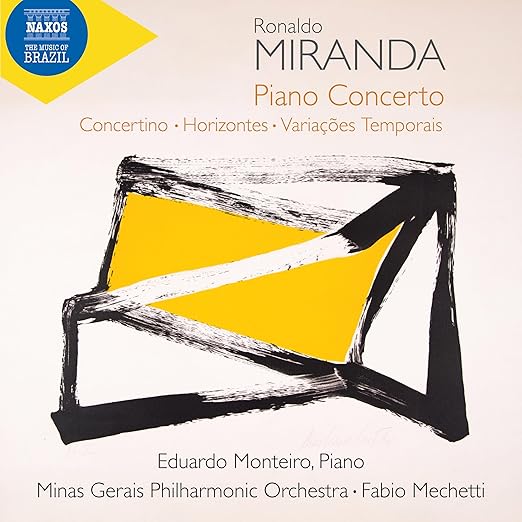
Miranda, R.: Piano Concerto, Horizontes, Concertino..., Variações Temporais…; Monteiro/Mechetti/MinGerPO [Naxos]
With this recent release, Naxos gives us more orchestral rarities from Brazil in conjunction with that country's Ministry of Foreign Affairs (MRE) . This time around they're by composer Ronaldo Miranda (b. 1948). What's more, three of them are world premiere recordings, and accordingly marked with a "WPR" after their titles.

Ronaldo was born in Rio de Janeiro, where he studied piano as well as composition at the Federal University's (UFRJ) School of Music. He then began his career in 1974 as a music critic for the Jornal do Brasil (JB), and some three years later (circa 1977) concentrated on composition.

Subsequently, Miranda has won many prizes, represented his country at several prestigious international musical events, and received a number of significant commissions since 2005. As of the last few years he's taught composition at the UFRJ and the University of São Paulo (USP), some 250 miles west-southwest of Rio. Consequently, to date he's apparently written a significant body of works across most genres, but unfortunately there's no readily available catalog of them as of this writing.

Composed for a commission from the Orquestra Sinfônica do Estado de São Paulo (OSESP), Ronaldo's Piano Concerto (1983; WPR) begins this disc. The first movement is sonata-form-like and marked "Tenso (Taut)" [T-1]. Its exposition opens with a rhythmically robust theme of Bartókian complexion [00:00], which is all the more feisty for the piano's percussive delivery. But the prevailing mood softens with a following more tuneful idea [01:29].

Then there's an extended development of the foregoing [03:32] rife with atonality, as well as punctualism. And after that, we get a capricious recapitulation [07:22] having a curt piano cadenza [08:41-09:06]. However, antic passages [09:08] followed by scurrying ones [10:51] end things uneventfully.

The brief second movement [T-2] is a "Grave (Solemn)" offering that's along the lines of the "Andante con moto (Slow with movement)" marked middle one in Ludwig van Beethoven's (1770-1827) Piano Concerto No. 4 in G major, Op. 58 (1805-06). Moreover, Miranda's opens with fortissimo, unison strings playing a plaintive thought that's soon joined by sorrowful piano ones [00:50].

But the mood turns quite droll in the "Lúdico (Playful)", closing movement [T-3]. This is a sportive theme-and-variations, which has a puckish, opening main subject first played by the orchestra [00:00]. It's then picked up by the soloist [00:16], and undergoes several variational treatments. These range from alacritous [00:33] to stealthy [01:10], whimsical [02:01, 03:23], capricious [03:371 as well as frantically fugal [04:45]. And after that, a lissome one [05:52] ends the work expeditiously.

Miranda's symphonic poem "Horizontes (Horizons)" of 1992 (WPR) is next. It's in three movements, and commemorates Christopher Columbus's (1451-1506) voyage to the New World. The initial "A Partida (Departure)" [T-4] has queasy beginning passages [00:00] that seem to reflect this man's anxiety about his impending venture. Then troubled trumpet calls [03:04] and harp glissandi [03:07] announce this explorer-navigator's three ships setting sail.

After that, there's "A Espera (Waiting)" [T-5], which begins with a soporific number [00:00]. It engenders a wistful episode indicative of the ships being becalmed and their crew members longing for home. But this music moves attacca into the closing "A Descoberta (Discovery)" [T-6] with chastened strings [00:00] succeeded by a solo clarinet call [00:04].

It denotes the arrival of a bird holding a twig in its beak, thereby indicating the proximity of land (shades of Noah and his dove). And after that a compelling minimalist titbit [01:24] ostensibly implies the sailors' excitement over that possibility. Then memories of the work's opening measures [03:14] end it tranquilly, presumably as a welcome shoreline comes into view.

Moving right along, we next get Ronaldo's two-movement Concertino for Piano and Strings (1986), where neotonality is much in evidence. The "Allegro enérgico (Fast and energetic)" marked first one [T-7] begins with skittering strings [00:00] and a jittery soloist [00:40] hinting at a jaunty tune soon played on the piano [01:01].

Then the foregoing is the subject of a captivating dialogue between the two [02:38]. It's succeeded by a brief pause and further musical discourse. This becomes quite lyrical [07:59] and ends the movement with glowing finality.

The "Allegretto (Fairly quick)" last one [T-8] is a rondo that's a delightful, "A-B-A-C-A" structured romp. It starts with everyone playing a catchy "A" refrain [00:00]. Then there's a Bartók-like "B" [00:47] followed by another "A" [02:06]. And after that, Miranda serves up a fugue-spiced Piazzolla-like "C" [02:43]. However, our old friend "A" returns [04:13] along with a virtuosic piano-laced coda [05:34], thereby ending the work with a 🙂.

Composed for another commission from OSESP (see above), Ronaldo's "Variações Temporais (Beethoven Revisitado) -- Temporal Variations (Beethoven Revisited)" of 2014 (WPR) closes this release [T-9]. It was originally intended to be an exordium for Beethoven's (1770-1827) Symphony No. 6 in F major, "Pastoral", Op. 68 (1802-08), but later expanded into what's here. Incidentally, the Portuguese word "Temporais" can mean "storm" as well as tempo.

The opening theme is a comely, Ludwig-like, songful number [00:00] having brief intimations of his "Spring" (1801), "Waldstein" (1804) and "Tempest" (1801-02) sonatas. It undergoes several variational treatments, which conjure up thoughts of a vernal day [01:24], raging blizzard [02:43], restful night [03:51], vorticose cyclone [05:17], stunning sunset [06:45] and star-studded skies [07:23]. Then stormy passages [07:43] end the piece as well as this disc with flashes of lightening [08:50] plus a clap of thunder [08:52].

All four performances are by the Minas Gerais Philharmonic Orchestra (MinGerPO), which is based in Belo Horizonte, some 270 miles north of Rio. Under its artistic director and principal conductor, São-Paulo-born Fabio Mechetti (b. !957), they're joined by internationally acclaimed, award-winning, Brazilian pianist-professor-teacher Eduardo Monteiro (b. 1966) for the first and third selections. Moreover, these superb musicians deliver committed, outstanding accounts of all four works, which will probably be definitive for some time to come.

The recordings were made 13-16 February 2023 at the Sala Minas Gerais in Belo Horizonte (see above). They consistently project a generous sonic image of these proceedings with Senhor Monteiro's piano placed front and center. It's ideally captured with just the right amount of percussive bite, and well highlighted against the orchestra. Generally speaking, the overall sound has a wide dynamic range for a conventional disc, where the instrumental timbre is characterized by acceptable highs, a good midrange, and clean bass.

-- Bob McQuiston, Classical Lost and Found (CLOFO.com, P250729)

- AVAILABILITY -
Amazon ArkivMusic.com


The album cover may not always appear.
Rózsa, M.: Sinfonia concertante…, Rhapsody…, Notturno ungherese…; Krijgh/Boriso-Glebsky/Bühl/DSpRh-Pf [Capriccio]
Hungarian composer Miklós Rózsa (1907-1995) last appeared in these pages about a year ago (see 31 May 2024 for his background). and here he is again courtesy of Capriccio. He was renowned for his film scores, but as before, this label serves up an additional three orchestral works written for the concert hall.

Our first selection is this composer's "Sinfonia concertante for violin, cello and orchestra, Op. 29" (1958), which was originally written for Jascha Heifetz (1901-1987) and Gregor Piatigorsky (1903-1976). Although it had a problematic inception (see the album booklet), in the end this turned out to be one of Rózsa's best concert creations.

The first of its three movements is marked "Adagio non troppo lento (Relaxed, but not overly so)" [T-1], and gets off to a rousing start with a vivacious theme for the orchestra [00:01], cello [00:06] and violin [00:15]. This wanes into a lovely, two-part, ethereal episode [01:25 & 03:39], which brackets a capricious, virtuosic one [02:49-03:38].

Then piqued passages [04:41] adjoin a spectacular violin-cello cadenza [05:23]. And after that, the tutti join in [08:12], thereby calling up melancholy memories of past measures. However, these bridge into an increasingly frenetic, bravura-ridden segment [08:12], which brings the movement to a thrilling conclusion.

It's followed by an "Andante (Flowing)" one that's a "Tema con variazioni (Theme and variations)" [T-2]. This has an initial, winsome theme that's played by the cello [00:00]. Then the violin and orchestra deliver the first, rather playful variation [01:27]. And subsequently, there are seven more. They range from somewhat jazzy [02:32] to impish [03:39], regal [04:28], pensive [07:58], pugnacious [07:37] and dreamy [08:48]. Then a tranquil one [10:45] ends things quietly.

The "Allegro con brio (Lively with spirit)" third movement [T-3] has a wild orchestral introduction [00:00] hinting at a cello-introduced frantic idea that soon appears [00:57]. Then all this gives way to a swaying countermelody [01:52], and the foregoing is material for a hectic episode [03:17], where both soloists scurry about.

But the aforementioned wanes into more subdued, romantic passages [05:33] based on that previous countermelody. However, this gradually grows quite maniacal [06:02], thereby closing the work with some fierce fiddling plus two fortissimo final chords for all [08:15].

Apparently, Rózsa once asserted that his style started with the "Rhapsody for cello and orchestra, Op. 3" (1929) [T-5], which he composed for Hans Münch-Holland (1899-1971), who was principal cellist of the Leipzig Gewandhaus Orchestra. What's more, he advised the composer about writing for his instrument, and consequently, the pervasive solos are quite consummate.

Moreover, this begins with one [00:00], which is soon seconded by the tutti [00:35], and becomes the subject of a dramatic serenade [01:33]. Then the music makes a delicate bridge into cantilena-like passages [02:28, 03:24, 03:56, 04:25].

However, these conjoin subdued, nostalgic, cello-tinged afterthoughts [04:49] having a couple of moving cadenzaesque moments [04:49, 05:30]. And subsequently, the foregoing become rapturous [08:03] with ecstatic solo titbits, plus spirited passages [12:51] followed by showy cello ones [14:03]. Then the latter end the piece with an exultant coda for all [15:32].

Memories of the composer's childhood are reflected in the remaining piece on this CD, which is titled "Nottorno ungherese (Hungarian Nocturne), Op. 28" (1972) [T-4]. It opens with a clarinet playing a solemn melody [00:00} to hushed accompaniment. Then this idea evokes increasingly impassioned passages of Magyar tinct.

These become somewhat peripatetic [03:08] as well as quite compelling, but then ebb into serene, delicate moments [05:43]. However, the latter wax and wane into subdued hints of the opening measures [07:57], which bring things to a somniferous conclusion.

As before (see 31 May 2024), the performances are by the Deutsche Staatsphilharmonie Rheinland-Pfalz (DSpRh-Pf), which is based in Ludwigshafen, some 600 miles west-northwest of Budapest. It's again under internationally acclaimed, German conductor, Gregor Bühl (b. 1964), and this time they're joined by Dutch cellist Harriet Krijgh (b. 1991) [T-1 thru 3 & 5] along with Russian violinist Nikita Boriso-Glebsky (b. 1985) [T-1 thru 3].

These musicians deliver magnificent renditions of all three selections. Once again, this music shows that although Rózsa may best be known for his film scores, he was equally talented at writing for the concert hall.

All three recordings were a coproduction of this orchestra, Deutschlandfunk Kultur (DLF Kultur), Südwestrundfunk (SWR) and Capriccio. They were made 19-23 February 2024 in Ludwigshafen Philharmonie Hall, and present a generous sonic image in pleasant surroundings.

The soloists are positioned just left (violin) and right (cello) of Maestro Bühl in the Sinfonia [T-1 thru 3]. However, the Rhapsody [T-5] finds the cello a bit more centered. In any case, both instruments are well captured as well as highlighted against the DSpRh-Pf, whose overall timbre is characterized by pleasant highs, adequate mids and clean bass.

-- Bob McQuiston, Classical Lost and Found (CLOFO.com, P250728)

- AVAILABILITY -
Amazon ArkivMusic.com


- SEE OTHER CLOFO SERVICES -
AUDIOPHILE SELECTIONS BEST FINDS OF LAST YEAR CLOFO HOME PAGE CLOFO RECOMMENDATIONS OTHER CROCKS NEWSLETTERS